


August 3, 2022
How to create a goal-oriented product design brief?
Read Full

Most companies that redesign for "multiple buyers" don't actually have multiple buyers. They have one buyer who behaves differently depending on the day, plus an internal fantasy about a persona who reads your site the way a CFO reads a board deck. The real question isn't whether your buyers differ - it's whether you've priced in what it costs to keep serving them separately once the site is live. We'll work through this as a sequence of decisions, in the order you'll actually hit them, because the failure mode is rarely "we didn't think about personas." It's "we thought about personas in a workshop, then built a site that doesn't match how anyone finds anything again."
Good B2B website design isn't about building a page for every buyer. It's about knowing which differences are real and refusing to pay for the ones that aren't. Every persona-specific path is a page that needs its own proof, its own call to action, and its own update when pricing or features change.
A site with one unified structure gets updated once. A site with four parallel journeys gets updated four times or, more often, gets updated once and drifts out of sync everywhere else, which is worse than never segmenting at all.
We've seen enterprise paths that still reference a feature renamed two versions ago, because whoever owns content updates forgot the path existed. You can see this pattern play out in our portfolio of work, where sites built with one clear owner per path stayed current far longer than sites split into four separately maintained journeys.
The first decision isn't how to segment. It's whether to.
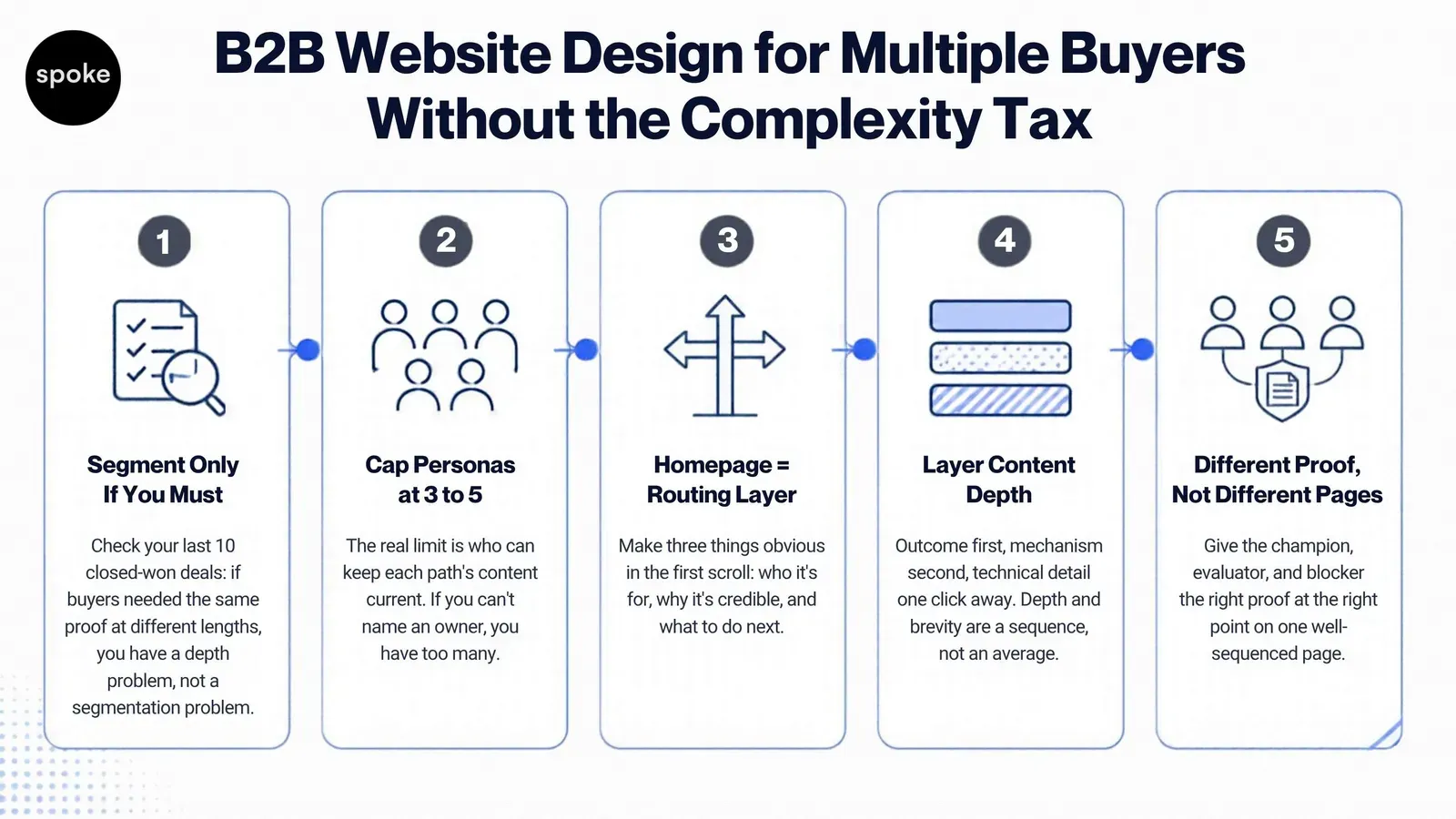
Pull up your last ten closed-won deals and ask whether the champion, the economic buyer, and the technical evaluator needed genuinely different proof, or whether they all needed the same three things explained at different lengths. If it's the latter, you don't have a segmentation problem. You have a depth problem, and depth is solved with structure on one page, not with three pages.
This matters more than it sounds, because most B2B research now happens before anyone talks to your sales team. Buyers doing independent research spend the large majority of their purchase journey working things out on their own, according to Forrester's research on buyer behavior, which means the site itself, not a rep, is doing most of the convincing before segmentation even becomes relevant.
If a technical evaluator and an economic buyer, reading the same page, would each be annoyed by half of it, you have a real case for segmentation. If they'd both skim to the part that matters to them and find it eventually, you don't.
There are three ways to slice a B2B audience, and picking the wrong one is how you end up with a dropdown that reads like a taxonomy instead of a doorway. Getting this axis right is mostly an exercise in thoughtful information architecture, not visual design.
This works when you can reliably predict which three or four roles show up in most deals. If your buying committee reshuffles from deal to deal, role-based routing will misfire more often than it helps.
You usually can't tell someone's stage from their first visit - you infer it from behavior, which is why this axis tends to live in follow-up content rather than your primary navigation.
If your "for healthcare" page is the same pitch with a different logo pasted over the hero, that's not segmentation. It's a maintenance liability with a costume on.
Three to five personas is a reasonable ceiling for most small and mid-sized B2B companies, per Bop Design's research on persona strategy - but the number itself is a symptom, not a target. The real constraint is how many distinct proof requirements your content team can credibly keep current.
Every persona you add multiplies content surface area: its own case studies, its own FAQ answers, its own CTA logic, its own path someone has to remember exists when the product changes. If you can't name who owns keeping the "for security teams" page accurate when your compliance status changes, you don't have five personas - you have one persona and four abandoned corners of your site.
A useful gut check: if a persona's version of your site would be identical to another's except for the headline, merge them. That's not two personas. That's one audience with a messaging variant, and it belongs in copy, not architecture.
The homepage's job is to make three decisions obvious in the first scroll: who this is for, why it's credible, and what to do next. It is not the place to say everything to everyone.
Speed compounds this problem: 40% of users abandon a site that takes more than three seconds to load, according to page load research, so routing complexity that slows the homepage down costs you before a visitor ever chooses a path.
This is where most segmented sites actually fail - and it's rarely the segmentation itself. It's that the homepage tries to be both the routing layer and the pitch, stacking three competing headlines and three CTAs on top of each other until nobody can tell if the page is talking to them or past them. Compare that to how a well-scoped design and development project typically resolves this: one clear statement of who you serve, one strong piece of proof, then two or three routing paths that match how visitors already think of themselves.
Collapsing detail behind an expandable section works well for optional depth - a fast-moving executive skips past it, a technical evaluator expands it and gets real substance without a separate maintained page. But hiding information a time-pressured buyer actually needs to decide just adds friction disguised as simplicity. Use it for depth that's genuinely optional, never for something someone needs to move forward.
Give personas different calls to action only when your business genuinely supports two different next steps - a self-serve trial and a sales-led demo - and you're prepared to staff and measure both as real pipelines. A trial CTA that quietly dead-ends into the same sales queue anyway breaks trust with the visitor who chose it expecting something different.
This is the question that sinks most attempts at B2B website design: how do you give a technical evaluator the spec sheet and an executive the ROI story on the same page without either feeling like the page wasn't written for them?
The answer is layering, not duplication. Put the outcome first - what changes for the business, in a sentence a non-technical buyer can repeat in a meeting. Follow it with the mechanism - how it works, in enough detail that a technical reader trusts you to understand the problem. Let genuine depth - architecture, API references, security documentation - live one click away, clearly labeled.
This kind of layering is usually easier to hold together inside a single Webflow build workflow than across a patchwork of persona-specific templates. The mistake is writing one paragraph trying to satisfy both readers at once. It reads like a compromise because it is one: comprehensive enough to bore the executive, vague enough to underwhelm the engineer. Depth and brevity aren't opposites you average together. They're a sequence.
The champion needs material they can forward without editing - a clear claim, clear evidence, nothing that requires translation for a skeptical colleague. The evaluator needs enough substance to satisfy their own scrutiny, and often to defend the choice later. The blocker - procurement, security, legal, or a skeptical exec who wasn't in the original pitch - needs credibility signals placed where they'll actually look: certifications, customer proof with real weight, a security page that doesn't require a sales call to reach.
None of this requires three separate journeys. It requires knowing which piece of proof needs to be visible at which point in a single, well-sequenced page, and which needs its own quiet, permanent home.
Build a separate landing page when a segment arrives through a channel that already tells you who they are - a vertical-specific campaign, a partner referral - and the content genuinely differs, not just the headline. Use shared pages with strong hierarchy when segments arrive through the same channels and self-identify once they're there. Separate pages for traffic you can't actually route to them just means more half-current pages dragging down the rest of your site's credibility.
A typical B2B purchase involves six to ten decision-makers, according to Gartner's buying committee research, though more recent estimates put the range as wide as five to sixteen depending on deal size - confirmation that "typical" isn't something to design against. A company under roughly fifty people usually hasn't validated that its buyer types are truly distinct yet. A mid-market company, big enough for real deal complexity but too lean to have a large sales team backstopping every visitor, is where the website does the most work. An enterprise company, where every deal is heavily customized, often needs the site to function less as persuasion and more as a credibility anchor, while the actual selling happens in rooms the website will never see.
|
Strategy |
Suited for |
Implementation effort |
Maintenance burden (18+ months) |
When it fails |
|
Single unified narrative |
One buyer type, one outcome, early-stage companies |
Low - one page, one content set |
Low - one place to update |
Genuinely different buyers get bored or lost |
|
Role-based segmentation |
Stable buying committee across deals |
Medium to high - pages per role plus routing |
High - every role path needs its own upkeep |
Committee composition shifts and roles stop matching |
|
Industry or use-case segmentation |
Product genuinely differs by vertical |
High - separate proof and positioning per vertical |
High - content decays unevenly across verticals |
Pages become relabeled copies of the same pitch |
|
Progressive segmentation |
Existing site, unclear if buyers truly diverge |
Low at first, rising as you layer in routing |
Moderate - grows only where data confirms divergence |
Teams never revisit and layering stalls halfway |
If you sell one thing to one kind of buyer with one outcome, skip this entirely. A single clear story beats three thin ones every time.
If your sales team already owns the narrative and customizes it deal by deal, a segmented site can create more conflict than clarity - reps resent a site that boxes in a pitch they're used to shaping live. Fix that alignment before touching the architecture.
If you're pre-product-market fit and still guessing at your buyers, segmentation is effort spent defending a hypothesis. Build the clearest version of your pitch first, watch who responds, and segment once you have behavior to design against instead of a persona deck from a workshop.
And if every deal is genuinely bespoke - true enterprise sales where no two committees look alike - don't force visitors into predetermined paths. Prove you're credible and current, and let customization happen in conversation.
Segmentation succeeds when each path shows different behavior, not just different traffic. If your "for technical teams" page and your "for executives" page have nearly identical bounce rates and drop-off points, you haven't built two experiences - you've built one experience with two URLs, and the fix is to merge them.
Watch for orphaned paths: a persona-specific journey that routes people in but has no clear next step once they arrive, so visitors wander back to the homepage looking for a way forward. This happens most often when routing gets built before anyone maps what happens after arrival.
Watch, too, for the honest signal that segmentation is adding friction rather than removing it: if visitors bounce off the routing choice itself - the "who are you" moment - before reaching any content, the ask came too early or used language your visitors don't use about themselves. This is closer to an information-architecture problem than a copy problem, and it's the kind of divergence-by-audience issue that Nielsen Norman Group's IA research has documented in multi-audience sites for years: the failure is structural, not stylistic.
If you sell one product to one kind of buyer, skip segmentation and put the effort into one page done well. B2B website design doesn't reward complexity for its own sake. If you have a stable, multi-role buying committee with proof needs that genuinely differ, segment by role and cap the count at three to five, limited by who can actually maintain each path. Mid-market teams should put the most architectural effort here; enterprise teams should spend it on credibility instead of forced routing.
If you're not sure which of these you are, that's worth settling before anything gets designed - and it's exactly what a B2B website design agency should help you work out before quoting a rebuild.
You can see how this plays out across more examples on our blog. When you're ready to talk through your specific buying committee, get in touch.
Q: How many personas is too many before the website becomes too complicated?
A: There's no fixed number, but three to five is a reasonable ceiling for most small and mid-sized B2B companies. The real limit isn't the count - it's whether someone on your team can keep each persona's proof current. If you can't name an owner for a path, you already have too many.
Q: Should I create separate landing pages or one experience with smart navigation?
A: Build separate pages only when a channel already tells you who's arriving and the content genuinely differs. If segments arrive through the same channels and self-identify once there, a shared page with a strong content hierarchy will perform better and cost less to maintain.
Q: Does every persona need its own call to action?
A: Only if your business actually supports and staffs multiple paths to purchase, like a trial and a demo. If you only have one real path, give every persona the same CTA and differentiate the proof that leads to it instead.
Q: How do I know if my segmentation is working instead of just adding complexity?
A: Compare behavior across paths, not just traffic volume. If role-specific pages show similar bounce rates, time on page, and drop-off points, they aren't actually serving different needs and should probably be merged. Also check for orphaned paths that route people in but leave them with no clear next step once they arrive.
Q: What if my buyers have conflicting needs - what goes above the fold?
A: Lead with the outcome that matters most to whoever is most likely to block the deal if unconvinced, usually the economic buyer or a procurement blocker, then layer mechanism and technical depth beneath it. Nobody needs everything explained in the first screen, and trying to fit it there satisfies no one.
Q: How do I handle a buyer who becomes the end user after purchase?
A: Treat pre-purchase and post-purchase as different moments needing different content, not different personas. The buying content can live on your main pages; onboarding and implementation content can live in a separate, clearly labeled resource area without needing its own persona-based architecture.
Q: Can I maintain consistent branding across role-specific journeys?
A: Yes, and you should. Branding should stay constant across every path while proof and depth vary by audience. Inconsistent tone across paths is usually a sign the pages were built by different teams at different times without a shared content model guiding them.
Let’s Connect.
Have a project in mind or want to explore how we can help your business grow?