

November 25, 2022
Truism: Poor Design vs. “Poor by Design”.
Read Full

Most redesigns don't fail in design. They fail in the six weeks before design starts, when nobody says out loud that Sales, Product and the CEO are describing three different websites. We've sat in enough of these rooms to know the disagreement isn't the problem the absence of a tiebreaker is. This is what to resolve before you brief anyone, what actually drives timeline and budget, and where the standard advice stops applying.
A redesign resets your information architecture, your content inventory, your URLs and your CMS. An optimization touches none of those. That distinction matters more than most briefs acknowledge, because companies that redesign when they only needed to optimize end up rebuilding things that weren't broken and reopening decisions nobody asked them to reopen.
There's a second case worth naming honestly. If leadership just changed go-to-market strategy, shifted ICP, or rebranded, the site redesign is downstream of that work, not a substitute for it. A redesign built on top of an unresolved positioning problem produces a beautiful site that still doesn't convert, because the words on it are still wrong. Discovery usually surfaces this before design does which is a feature of the process, not a delay to resent.
If you can name the fix as "rewrite this page" or "improve this flow," that's optimization. If the only honest description is "nobody can find anything" or "we have five products and one flat navigation," that's a redesign. A redesign is warranted when the IA no longer reflects how the company sells, the CMS can't support the content types marketing needs, or the brand has outgrown the site's narrative entirely.
A refresh is the right call when the problem is narrower: flat messaging on specific pages, a weak conversion flow, dated visuals sitting on top of architecture that still works. Treating every narrow problem as a full redesign is how a six-week fix becomes a six-month replatform. A build done through steady Webflow design work often costs less than people expect once the scope is correctly sized.
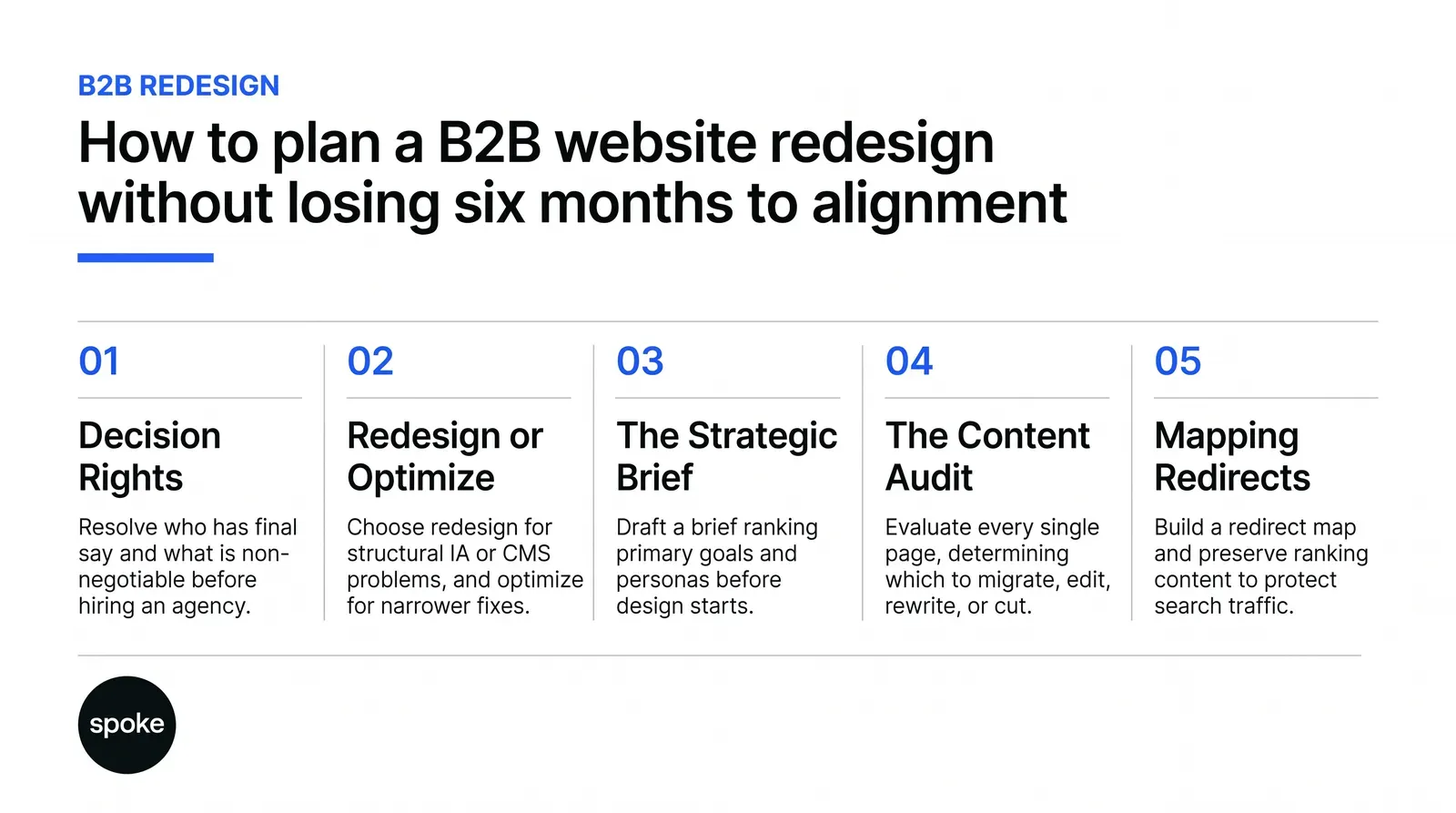
Unclear decision rights extend projects by weeks every time, because every ambiguous call gets relitigated later instead of settled once. Before anyone writes a brief, three things need resolving internally: what the site is primarily for, ranked rather than listed; who has final sign-off when two legitimate opinions disagree; and what's non-negotiable legal constraints, locked brand guidelines, platform decisions already made stated plainly rather than discovered in week six.
A RACI structure is worth building even if your company doesn't normally use one, because the value isn't the document, it's the conversation it forces. For a mid-size company that split typically looks like one person Accountable for the outcome, a working team Responsible for delivery, Sales and Product and IT Consulted for data they uniquely hold, and leadership Informed rather than deciding.
Marketing sees the site as a lead-generation engine. Sales sees it as a credibility check prospects run before a call. IT cares about what they'll maintain in eighteen months. None of them are wrong. If the Accountable person isn't named and empowered before design starts, every group gets a chance to reopen a settled decision during review and that's where approved timelines slip.
A strategic brief is the actual deliverable of discovery, and it needs to state four things in writing: the site's primary and secondary goals, ranked; the priority personas and what each needs to find; the content in scope versus out; and the decision-rights structure from stakeholder mapping. Design that starts without this isn't starting early it's guessing, and the guesses get corrected later, in a more expensive medium.
Discovery and strategy typically run two to three weeks for a site of moderate complexity, covering stakeholder interviews, a competitive scan, a technical audit and goals definition. If budget or timeline won't support that, compress the breadth of fewer interviews, a lighter scan but keep the content audit and the decision-rights conversation, since those two prevent rework and everything else is depth.
The content audit itself needs a call on every existing page, not just the top performers: keep as-is, migrate with light edits, rewrite, consolidate, or kill. Pages that rank for nothing and convert nothing are the ones teams are most anxious about cutting and most wrong to keep bloating the new IA and give stakeholders something to defend purely because it already exists.
The honest trade-off: a full rewrite produces on-brand, optimized copy but consumes a large share of the project budget, because its research and approval cycles are disguised as writing. Migrating existing content is faster and cheaper, but it carries forward whatever messaging problem the old site had which is a real risk if discovery already revealed that messaging was the root issue. Firms doing structured Webflow development will usually flag this trade-off during scoping rather than after the quote is signed.
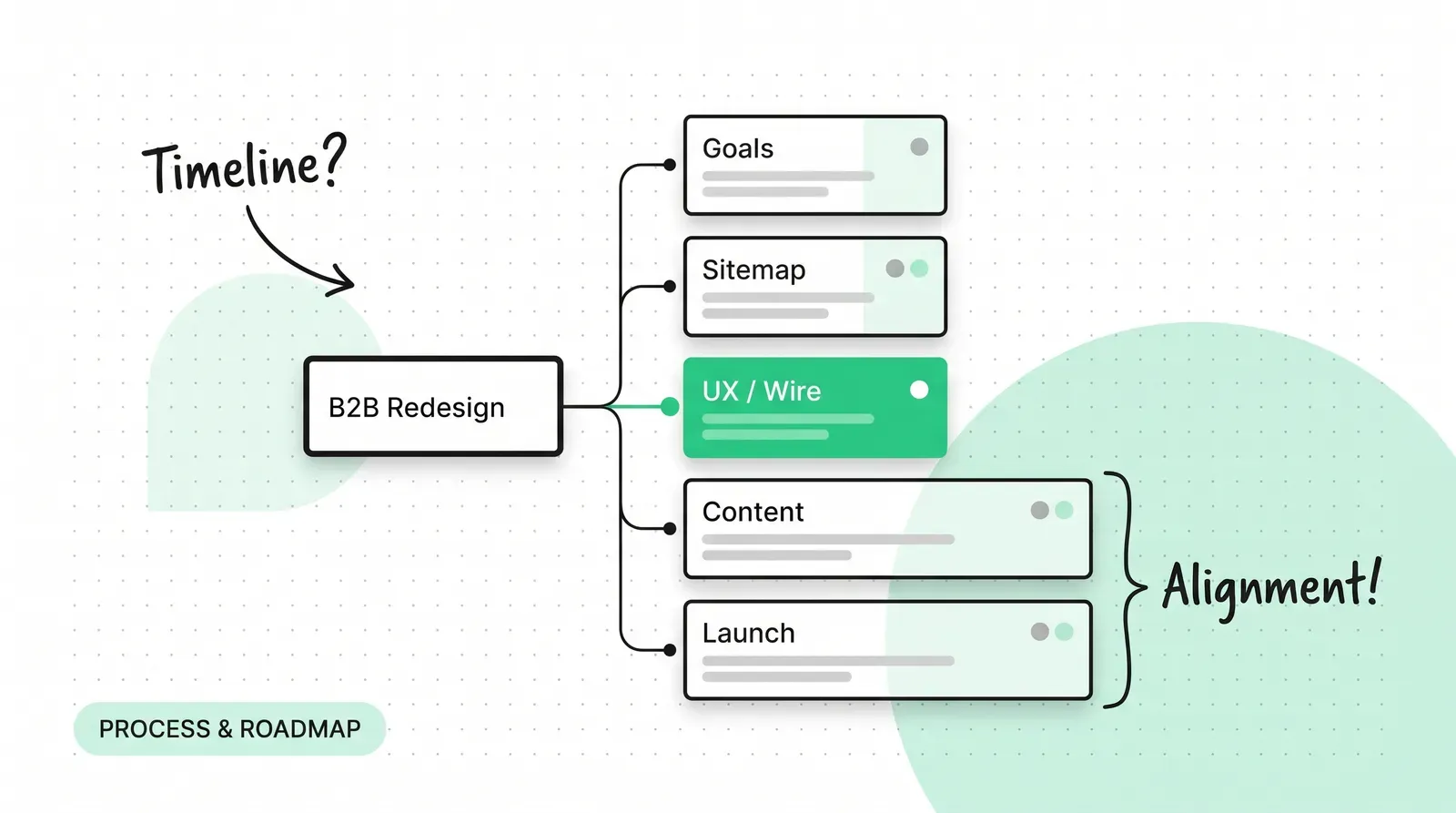
The standard sequence discovery, strategy, content, IA, design, development, QA, launch isn't bureaucratic caution. Each phase constrains the one after it. The expensive version of skipping this is running design and IA in parallel: layout decisions depend on how much content a page holds and how it relates to others, and if IA is still moving, design gets rebuilt once it settles somewhere different.
Not everything has to be strictly sequential, though. Content writing and discovery can often run side by side if the content is isolated to pages whose scope isn't contested. The rule isn't "nothing happens at once" , it's don't run two phases in parallel if one produces an input the other depends on.
One sequencing problem is structural rather than a mistake: content being fully "finalized" before design starts is the textbook order, but marketers often don't know which messaging actually works until they see it next to a visual hierarchy in a wireframe. That's a legitimate reason to treat early design as a working draft but only if everyone agrees upfront that it's a draft, not a final layout that then has to be rebuilt around different copy length.
The core task is a URL inventory and redirect map built before launch, covering every indexed URL, not just the obvious ones. Google's site migration guidance is the right technical reference here: map old URL to new URL 1:1 wherever possible, use permanent redirects, and preserve the content that earned the ranking, not just the address it lived at.
The common failure is specific: redirect maps built by category rather than checked individually, where a handful of rows point to the wrong destination. Because ranking changes lag by weeks, traffic on specific keywords disappears and nobody notices until a monthly report catches it, by which point the gap has been open long enough that recovery takes real time.
The quieter killer is content parity. A page that ranked well gets a new URL and materially different content at relaunch, and the ranking signal doesn't transfer just because the redirect is correct. If a page was already ranking, decide deliberately whether you're preserving its core content with a design update or replacing it outright and if you're replacing it, expect a ranking reset rather than a carryover.
Published ranges put small-to-mid-size redesigns at roughly eight to sixteen weeks and enterprise redesigns at six to twelve months, but those numbers mean different things depending on approval structure, not just page count. At a fifty-to-hundred-person company, the site might be a modest thirty to fifty pages, but the approval chain running through CEO, marketing, sales and IT is often the longer pole, not the build itself.
At two hundred to five hundred people, the complication tends to be federated multiple business units wanting their own say which needs an explicit governance model or the alignment phase alone outruns the build. At enterprise scale, custom integrations, legal review cycles and large page migrations make six-to-twelve-month timelines normal; that's the actual scope, not inefficiency.
Template system design is a quieter cost lever. A smaller set of well-designed, reusable templates cuts both build cost and maintenance burden, since marketing can build new pages later without engineering.
Checking a build against Core Web Vitals benchmarks early also avoids a round of performance rework right before launch.
More on how these trade-offs play out is in our blog resources on project scoping.
Scope creep during design is almost always a strategy decision getting reopened in review because it was deferred rather than resolved. The fix is making sure the strategic brief states the decision in writing, with a name attached, so "I don't remember agreeing to that" isn't an option in week ten.
Approval paralysis happens when decision rights were never named, and it compounds with staff turnover mid-project when a new stakeholder joins with full opinions and no context, and alignment effectively restarts. Phased launch limbo is its own failure mode: Phase 1 ships on schedule, Phase 2 gets deprioritized against other roadmap work, and the site sits half old, half new, for longer than anyone planned which reads as unfinished rather than in-progress, and damages the brand more than either version alone would.
A CMS mismatch surfaces months after launch, not at launch: the platform chosen at kickoff turns out to need developer involvement for routine changes, so landing pages queue behind engineering priorities and the velocity the redesign promised never shows up. Pre-launch QA should also check against WCAG 2.2 standards, which is the current accessibility benchmark, not an aspirational one skipping it is a common and avoidable gap.
Our case studies cover a few of these failure modes in more detail.
|
Launch approach |
Time to 100% new site |
Risk to search traffic |
Operational complexity |
Timeline & cost pressure |
|
Big-bang (entire site live day one) |
Immediate |
Higher all redirects land at once, errors surface everywhere simultaneously |
Lower ongoing complexity, but requires everything ready together |
Front-loaded: nothing ships until it's all done |
|
Phased (homepage and key pages, then the rest) |
Spread across later phases |
Lower per phase, but fragmented experience in between |
Higher two site states coexist, needs active management |
Spreads cost, but risks Phase 2 slipping indefinitely |
|
Gradual rollout (traffic split old/new) |
Over several weeks |
Moderate issues surface on a subset before full exposure |
Needs routing infrastructure and active monitoring |
Adds overhead but catches problems early |
|
Parallel run (both live, opt-in to new) |
Extended, no fixed deadline |
Lowest immediate risk, but dilutes SEO signal consolidation |
Highest maintaining two live sites is real ongoing work |
Lowest pressure, but risks never fully cutting over |
A 30-page site with stable navigation is often lower-risk as a big-bang launch than as a phased one, because phasing adds coordination risk without much benefit on something small enough to QA completely beforehand. Phased launches earn their complexity on large sites, or on budget-constrained projects where shipping Phase 1 starts generating value before the full build is funded but only if Phase 2 has a real, staffed schedule behind it.
If your budget genuinely can't support a multi-week discovery phase, don't skip it, compress it to decision rights, the content audit and the strategic brief, and treat everything else as depth rather than necessity. If stakeholder conflict is political rather than a difference of opinion, more alignment meetings won't resolve it; build a prototype and test the competing approaches with real users instead, because evidence settles arguments discussion doesn't.
If you don't have dedicated development capacity for a second launch phase, don't commit to a phased plan hoping the capacity appears later. Plan around the launch model you can actually staff, not the one that looks most polished in a kickoff deck. This is also where a web design and development partner worth hiring will push back on your preferred launch model rather than agree with it.
If your site's problem is narrow flat copy, a weak flow, dated visuals over working architecture, don't run a full b2b website redesign; fix the specific thing and save the budget. If the problem is structural IA that doesn't match how you sell, a CMS that can't keep up, a narrative the company has outgrown the redesign is the right call, but its success depends far more on decision rights and sequencing than on the design work itself. Compress discovery if you must, but never skip the content audit or the tiebreaker conversation.
For companies evaluating a webflow agency USA teams can actually hold accountable to that sequencing, the decisions above matter more than the platform choice. When you're ready to scope yours, get in touch.
Q: How do I know if we need a redesign or just optimization?
A: If you can describe the fix as rewriting one page or improving one flow, that's optimization. If the only honest description involves the whole navigation or a CMS that can't support your content, that's structural, and optimization won't hold. Run a quick content and IA review before committing either way it usually makes the answer obvious within a week.
Q: What happens between design approval and launch that costs so much time?
A: Development, content finalization, QA across devices and browsers, redirect mapping, and accessibility checks all happen in this window, and they're frequently underestimated because they look mechanical. The biggest time cost is usually stakeholder review cycles that reopen decisions assumed settled at approval. Naming decision rights earlier prevents most of this.
Q: How do we get Sales, Product and IT to agree on what the site should do?
A: They won't fully agree, and that's fine the goal is a named tiebreaker, not consensus. Interview each group separately before drafting the strategic brief, rank the goals explicitly, and have one accountable person empowered to make the final call when priorities conflict during review.
Let’s Connect.
Have a project in mind or want to explore how we can help your business grow?